
Common Spring Pests to Be on the Lookout For

Prevent spring pests by spring cleaning your Sevierville TN home. Get tips from Johnson Pest Control! Spring is almost here in the Sevierville area, and many people are welcoming the warmer weather. Unfortunately, with the spring season comes the pest season. This time of year, many pests that may have been less active in the winter have a resurgence of sorts. To prevent the many types of pests that will likely look to invade your Tennessee home, itโ€™s important to implement some pest prevention measures into your spring cleaning routine! Read on for top tips from the experts at Johnson Pest Control.

Spring Pests in Tennessee

While many of the following pests are active all year long, they are particularly in action starting in the spring months. There are five pests in particular that create trouble for property owners every spring: ants, stinging insects (wasps and hornets), stink bugs, termites, and rodents! Spring is simply the start of the pest season and can last well into the summer if pest control isnโ€™t implemented right away. By safeguarding your property now, you can help lessen the risk of getting an infestation as pests become more and more active.

5 Spring Cleaning Tips for Pest Prevention

With so many people planning to clean their home for springtime anyway, itโ€™s the perfect opportunity to implement pest control measures. For the best chance of making your home unsavory for pests, try the following tips:

  1. Tidy up! Clean under furniture, wipe down surfaces, and inspect areas of your home that need some fixing up.
  2. Clean your windows and doors thoroughly. If you find any cracks or crevices make sure to securely seal them.
  3. Deep-clean your carpets and rugs. Vacuum, shampoo, or even steam-clean the surface.
  4. Sanitize and clean your kitchen with a focus on your appliances. Crumbs and spilled liquids welcome all types of insects and pests.
  5. Remove debris from your yard, and trim any shrubs or tree branches away from your home. Clear out your gutters and downspouts.

You Have Pests in the Springโ€”Now What?

Sometimes pests are inevitable, especially this time of year. For your best chance at controlling active infestations and preventing future ones, the exterminators at Johnson can help. Our team will work with you to develop a custom pest control plan suited to the needs of your property.
How to Differentiate Between Termites & Carpenter Ants

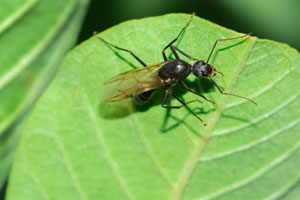
Carpenter ants are commonly mistaken for termites in Sevierville TN - Learn the differences from Johnson Pest Control.With spring upon us here in Sevierville TN, swarming insect season is coming! The most dangerous insects to be wary of this time of year are termites and carpenter ants. These two wood-destroying insects are commonly mistaken for each other in the swarmer stages of their lives. Although they are similar in appearance and habits, there are a few key differences to be aware of. Read on for tips from the experts at Johnson Pest Control for how to tell the difference between these insects.
How to Tell the Difference Between Termites & Carpenter Ants

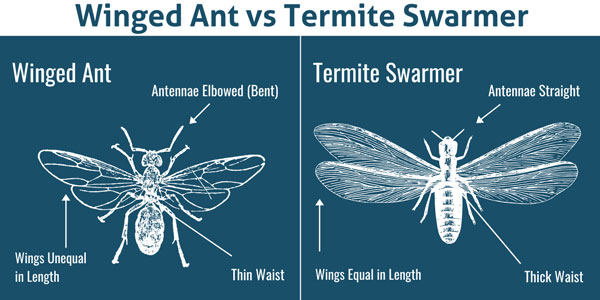
It can be difficult to tell apart termites and carpenter ants in the swarmer stage. Itโ€™s important to look at the size of their wings in proportion to their bodies:

  1. Carpenter ant swarmers: These are black in color, with some species having slightly red coloring. Carpenter ants measure 1/2โ€ณโ€“5/8โ€ณ with antenna bent at a 45-degree angle. Their wings are translucent with a reddish brown hue, laying over the posterior of the ant. Carpenter ant swarmers are bigger than termite swarmers!
  2. Termite swarmers: Usually, termite swarmers are black to brown in color and measure 3/8โ€ณ long including the wings. Their wings are a translucent to slightly milky or smoky color. Their wings may overlap, and are typically as long as or slightly longer than the body; this is the best way to differentiate them from carpenter ants.

Winged ant vs. termite in Sevierville TN - Johnson Pest Control

Termite Damage vs. Carpenter Ant Damage

Termites typically cause more damage than carpenter ants. Some of the things to know about these wood-destroying insects include:

  • Termites make their way into a structure around basement windows, doorways, under siding, porches, or any structure in contact with the soil.
  • Established termite colonies can range from 60,000 to over a million workers and can consume nearly 5 grams of wood per day.
  • Carpenter ants establish nests in wood that is already in decay, and later expand into normal wood, insulation, or wall voids.
  • Excavated termite galleries appear to have been sanded. For the most part, carpenter ants do not create the extensive damage termites do.ย 

Wood-Destroying Insect Extermination

Without a doubt, wood-destroying insects cause a lot of damage for property owners. However, termites can cause much more damage in the same period of time as carpenter ants. Regardless, itโ€™s important to enlist professional help for either of these insects. At Johnson, our termite exterminators will conduct a thorough inspection on your property to determine whether youโ€™re dealing with carpenter ants or termites. From there, we will work to exterminate these wood-boring insects with the most effective, fast-acting treatments!

Do You Wanna Eat Some Termites?..

So if you are planning some travel in the coming weeks, or maybe in the summer. You might want to prep yourself for some really unique foods that you could experience in your travels.

But, hopefully you wouldn’t get so unique that you’d need to figure out how to cook termites. Though, apparently they are quite tasty.

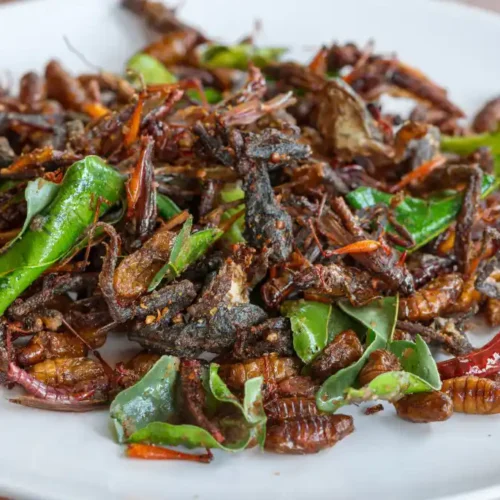
A plate of cooked insects

Yahoo Travel news found some of “The Weirdest Foods in the World”.

โ€œWhen I was in Mexico City with Afar Experiences, I got the chance to eat ants, crickets, and beetles at Mercado de la Merced, Mexico City. Andย I would eat them again in a second! They were good: salty and crunchy. kind of like sunflower seeds. I had always wanted to try food like that, especially now that bugs are being talked about as an increasingly important food source, but I guess Iโ€™d never had the opportunity. It was definitely easier to go to the market with a guide, Lesley Tellez, who knew where to find this stuff (the market was gargantuan, I never wouldโ€™ve made it through there on my own) and who could hold our hands a little, explaining what the stuff was, and taking us to a vendor who didnโ€™t mind a bunch of gringos making funny faces as we tried everything.โ€ โ€” Jeremy Saum, executive editor

โ€œI lived with a family in Kenya in a rural village just north of Lake Victoria. I was teaching English and Biology at the local school and my family took care of preparing most of my meals. EVERY DAY for at least two meals we ate the same corn porridge (ugali) and greens (sakuma wiki), so when the opportunity to try roasted and salted termites was offered, I jumped. They were crunchy, nutty, andโ€”most importantlyโ€”different!โ€ โ€”Jordan Robbins, corporate & donor relations development officer, Learning AFAR

So what has been some of the weirdest stuff you have eaten? Do you think you would eat termites, ants, caterpillars, grubs, etc.? I am not sure I could bring myself to doing that, but as the one correspondent, Jordan, mentioned if there wasn’t much to be eating I might jump at the chance for something new, even if it is probably gross. It is all protein isn’t it. Why not?